Understanding dandruff
The description is a starting point. The explanation requires a broader view.
The explanation involves several interacting factors: sebaceous secretions, Malassezia yeasts on the skin surface, and individual susceptibility. Malassezia alone does not explain dandruff, because these yeasts also occur on healthy scalps.
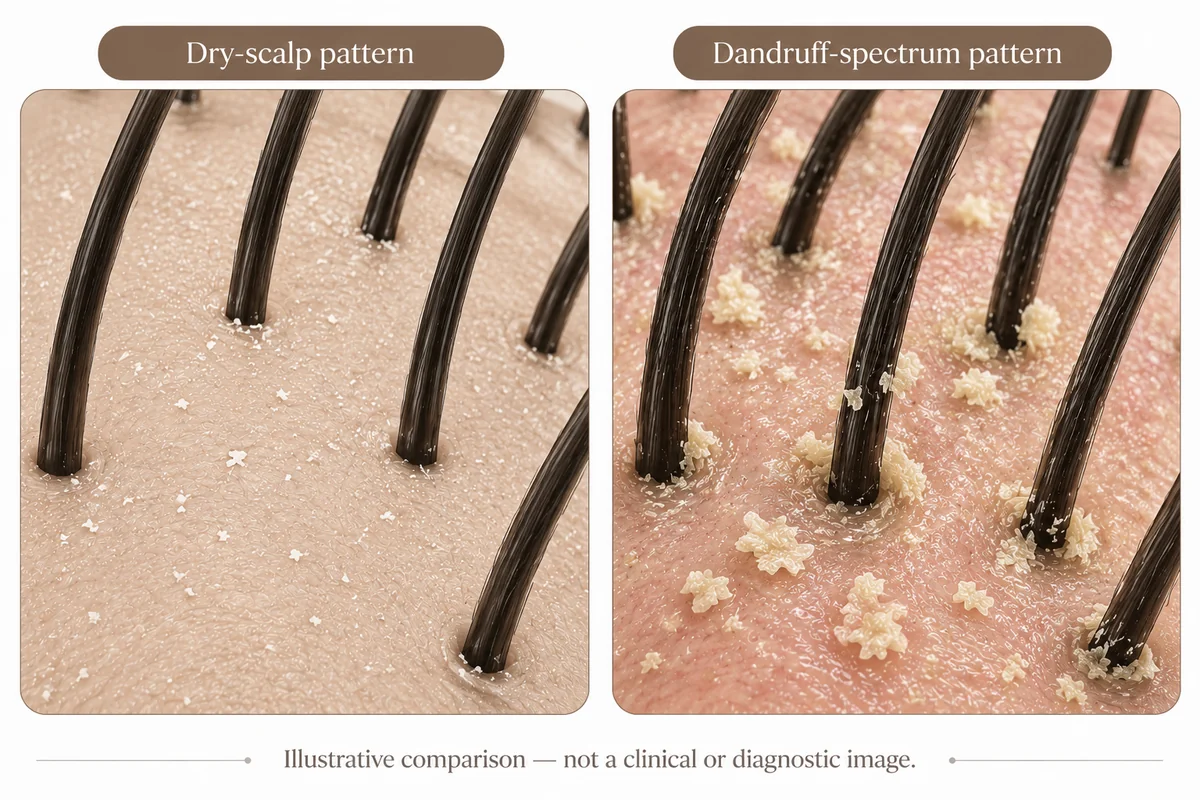
How skin cells become visible flakes
The skin’s outer layer is built from flattened cells called corneocytes. Connections between neighbouring cells help hold that layer together. During normal shedding, those connections are broken down in a controlled way so surface cells can be released. The technical term for this shedding process is desquamation.
Dandruff research has examined how that release process changes. A study of scalp samples found that cell-to-cell connections called corneodesmosomes persisted in an altered pattern in dandruff lesions, alongside increased levels of proteins that inhibit certain enzymes. This supports an explanation involving disturbed cell cohesion and shedding.
What Malassezia is doing on the scalp
Malassezia also has a metabolic role. M. globosa produces lipase, an enzyme that acts on lipids, and expression of a Malassezia lipase has been detected on human scalp. This helps explain why researchers consider the yeast’s activity and the surrounding scalp environment together, rather than interpreting its presence alone as the explanation.
Why microbial balance matters
Research comparing scalps with and without dandruff has found differences in the relative balance of bacteria and fungi. A French cohort linked dandruff with higher Malassezia restricta and Staphylococcus epidermidis and lower Propionibacterium acnes, now generally called Cutibacterium acnes.
A systematic review also reported a recurring pattern of altered microbial ratios in seborrheic dermatitis and dandruff.
Where the scalp barrier fits
Barrier function includes limiting water loss through the skin. Higher measured water loss and disorganized barrier lipids have been reported in dandruff research. Surface oiliness and the organization of the skin’s barrier lipids are different aspects of that picture.
The stratum corneum, the skin’s outer layer, is another part of the picture. Research reviews describe disrupted barrier lipids and increased water loss in dandruff, and propose that barrier changes can increase susceptibility to Malassezia metabolites.
What professionals should understand
Use the science to understand the model before applying a label.
For practitioner education, the important point is that flaking is discussed through interacting skin, microbial and susceptibility factors. A single-organism explanation leaves out part of that model.
What this page can — and cannot — tell you
Scope: This page provides a conceptual overview of dandruff, its relationship to seborrheic dermatitis, microbial balance and barrier research. The descriptions are educational, not a checklist for diagnosing a client. It does not differentiate every cause of flaking, establish a service-safety or referral decision rule, recommend products or active ingredients, or provide medication or treatment protocols.
The general clinical overview is a narrative review, not a systematic review, and its treatment discussion reflects older evidence not used here as a current protocol.
The French microbiome study was observational, relatively small, and population-specific; association does not establish causation, and the study involved industry funding and industry-employed authors.
The barrier review was written by industry authors and is not a clinical trial; some barrier–Malassezia mechanisms remain inferential, and the systematic review's literature search ended at a stated date rather than covering all later publications.
The corneodesmosome study used laboratory analysis of scalp samples rather than testing a service or treatment, and its authors overlap with the barrier review, so these are not fully independent lines of evidence.
The lipid-metabolism source summarizes biochemical and genome-analysis work, not a salon-service trial, and its author was industry-affiliated.
Key takeaways
-
01
Dandruff is generally described as scalp flaking, sometimes with itching, without visible inflammation. It is discussed alongside seborrheic dermatitis, which includes inflammation and may affect areas beyond the scalp.
-
02
The explanation involves several interacting factors: sebaceous secretions, Malassezia yeasts on the skin surface, and individual susceptibility. Malassezia alone does not explain dandruff, because these yeasts also occur on healthy scalps.
-
03
The stratum corneum, the skin’s outer layer, is another part of the picture. Research reviews describe disrupted barrier lipids and increased water loss in dandruff, and propose that barrier changes can increase susceptibility to Malassezia metabolites.
Sources & references
The cleared source set supporting this page's evidence review.
- Luis J. Borda, Tongyu C. Wikramanayake. Seborrheic Dermatitis and Dandruff: A Comprehensive Review
- G. A. Turner, Michael Hoptroff, Clive R. Harding. Stratum corneum dysfunction in dandruff
- Cécile Clavaud, Roland Jourdain, Avner Bar-Hen, Magali Tichit, Christiane Bouchier, Florence Pouradier, Charles El Rawadi, Jacques Guillot, Florence Ménard-Szczebara, Lionel Breton, Jean-Paul Latgé, Isabelle Mouyna. Dandruff Is Associated with Disequilibrium in the Proportion of the Major Bacterial and Fungal Populations Colonizing the Scalp
- Rong Tao, Ruoyu Li, Ruojun Wang. Skin microbiome alterations in seborrheic dermatitis and dandruff: A systematic review
- B. Singh, M. Haftek, C. R. Harding. Retention of corneodesmosomes and increased expression of protease inhibitors in dandruff
- Thomas L. Dawson Jr.. Malassezia globosa and restricta: Breakthrough Understanding of the Etiology and Treatment of Dandruff and Seborrheic Dermatitis through Whole-Genome Analysis